
Not every customer makes a decision in a few seconds.
Some purchases require research, comparison, discussion, trust, and repeated exposure before a person is ready to take action.
This is especially true for businesses in healthcare, finance, education, real estate, technology, legal services, B2B manufacturing, consulting, premium consumer products, insurance, infrastructure, and high-value services.
A person may see an advertisement and remember the brand.
But before they book a consultation, request a proposal, contact the sales team, invest in a product, choose a provider, or recommend the business to someone else, they need confidence.
They need to believe that the company understands the problem.
They need proof that the brand is credible.
They need clarity about what will happen next.
They need to feel that the business is professional, prepared, visible, and trustworthy.
This is why high-consideration marketing should not begin with one question:
How do we get more leads?
It should begin with a better question:
What would make the right person trust us enough to enquire?
The answer is rarely one advertisement.
Trust is built through multiple signals working together.
A clear website. A credible announcement. A useful video. A strong event. A visible expert. A trusted media environment. A local-language message. A consistent social presence. A simple enquiry process.
This guide explains how businesses can use those signals to build a trust-first growth system.
Trust Is Not a Soft Metric. It Is a Business Asset.
Many brands treat trust as something abstract.
They focus on performance advertising, clicks, impressions, leads, and cost per enquiry. These numbers matter, but they do not explain why one brand gets chosen while another is ignored.
Trust affects every stage of the buyer journey.
It affects whether someone clicks an advertisement.
It affects whether they stay on a website.
It affects whether they fill out a form.
It affects whether they answer a sales call.
It affects whether they compare price alone or consider value.
It affects whether they refer the business to someone else.
A company can have a great product and still lose business if it appears unclear, invisible, inconsistent, or unprepared.
The strongest brands create confidence before the sales conversation begins.
They make it easy for people to understand:
- What the company does
- Who it serves
- What problem it solves
- Why the offering is credible
- What makes the brand different
- What proof supports its claims
- How a customer can take the next step
Trust should be visible long before a prospect speaks to the sales team.
Start With Newsworthy Communication, Not Promotional Noise
A business announcement should do more than say, “We are excited to announce.”
It should give people a reason to care.
A launch, expansion, partnership, new product, leadership appointment, certification, milestone, investment, research finding, community initiative, or new service can become useful communication when it is framed around relevance.
For example, a company should not simply announce that it has opened a new office.
It should explain what that expansion means for customers, the market, local employment, service availability, response times, or future growth.
A professional press release writing and distribution strategy helps businesses turn important developments into clear, structured communication that journalists, customers, partners, employees, and investors can understand.
A strong press release should answer:
- What happened?
- Why does it matter?
- Who is affected?
- What problem does it solve?
- What evidence supports the announcement?
- Who can provide expert context?
- What should an interested reader do next?
The goal is not to force every business update into the news.
The goal is to identify the developments that genuinely deserve attention and communicate them with clarity.
A useful announcement can become a press story, website update, LinkedIn post, email campaign, founder video, sales asset, and long-term proof point.
Turn Important Announcements Into Meaningful Media Moments
A press release is valuable, but a real media moment can create stronger attention.
A business can create this through a product launch, press interaction, media preview, leadership conversation, industry gathering, demonstration, panel discussion, launch event, report release, or community initiative.
The format depends on the nature of the business.
A consumer brand may invite media and creators to experience a product launch.
A healthcare organisation may host an awareness discussion with specialists.
A technology business may demonstrate a new platform.
A real-estate developer may showcase a project vision.
A manufacturer may invite industry stakeholders to see a facility or product demonstration.
A strong press and media event management approach helps ensure that the event is built for communication, not just attendance.
A media-facing event should include:
- A clear central message
- A credible spokesperson
- Relevant visuals
- Talking points for interviews
- Product or service demonstrations
- Photography and video planning
- Media-friendly information
- A follow-up content plan
- A simple action path for interested audiences
The event should not end when guests leave.
It should become an asset library.
The keynote can become a video.
The demonstration can become a social-media clip.
The founder interview can become an article.
The event photographs can support press coverage.
The audience questions can guide future content.
The media story can create a stronger digital footprint.
That is how a one-day activity becomes long-term brand value.
Use Expert Conversations to Explain What Advertising Cannot
Some businesses need more than a slogan.
They need education.
This is particularly true for technical services, healthcare, finance, professional consulting, law, technology, industrial products, education, premium products, and B2B offerings.
A customer may need to understand the problem before they are ready to understand the solution.
This is where podcast-style conversations, founder discussions, expert interviews, industry panels, and long-form educational videos become useful.
A professional podcast video editing service can help businesses turn expert conversations into polished long-form episodes, short clips, captioned social videos, audiograms, and platform-ready content.
A single expert conversation can become:
- A full podcast episode
- Short LinkedIn clips
- Instagram Reels
- YouTube Shorts
- Founder quotes
- Customer education videos
- Sales follow-up content
- Website resources
- Email newsletter content
- FAQ answers
- Industry insights
- Search-friendly article ideas
The most effective expert content does not sound like a sales pitch.
It answers real questions.
It helps the audience make a better decision.
It shows that the brand understands the category, the customer, and the problem.
When people learn from a company before they buy from it, the business becomes easier to trust.
Make Complex Services Visible Through Better Visual Explanation
A major problem for high-consideration businesses is that their value can be difficult to show.
A healthcare provider may need to explain a complex procedure.
A medical-device company may need to demonstrate how a technology works.
A manufacturer may need to show internal machinery.
A software company may need to explain a process that cannot be photographed.
A real-estate developer may need to show a future project before it exists.
A service business may need to make an invisible process feel clear and tangible.
This is where visual communication becomes powerful.
For medical, health-tech, pharmaceutical, research, and care-related communication, 3D medical animation can help explain processes, products, anatomy, treatments, workflows, and technical concepts more clearly.
High-quality visual explanation can help businesses show:
- How a treatment or procedure works
- How a product works internally
- How a technical service creates value
- What happens before, during, and after a process
- Why a solution is different
- How a complex system connects
- What customers should expect
The purpose of visual content is not to make a business look more complicated.
It is to make a complex decision feel easier.
The more clearly a customer understands the offering, the more confidently they can take the next step.
Build Trust Through Consistent Social Proof
Trust does not come only from major campaigns.
It also comes from what people see repeatedly.
A brand that shares useful updates, customer stories, behind-the-scenes work, team expertise, community involvement, event moments, explanations, and real outcomes creates a more complete picture of itself.
This is especially important for mission-led organisations, foundations, education initiatives, healthcare awareness campaigns, community projects, and purpose-driven brands.
A structured social media management approach for nonprofits demonstrates the importance of consistent storytelling, supporter engagement, campaign planning, and community-focused communication.
The same principle applies to commercial brands.
A strong social presence should not only post offers.
It should communicate proof.
That proof may include:
- Customer testimonials
- Team expertise
- Product demonstrations
- Founder insights
- Case studies
- Community work
- Behind-the-scenes processes
- Educational posts
- Industry observations
- Event highlights
- Media coverage
- Awards and certifications
- Partner stories
The objective is not to post every day without purpose.
The objective is to make the business feel active, credible, approachable, and real.
Use the Right Media Environment for Financial and High-Trust Decisions
When people make decisions about finance, investing, insurance, loans, business growth, wealth, property, or major purchases, the context of the message matters.
A financial product or service cannot rely only on flashy creative.
The audience needs clarity, relevance, and confidence.
A well-placed finance-focused campaign can help a business appear in an environment where people are already thinking about money, growth, risk, planning, and long-term decisions.
A Money9 advertising strategy for finance brands can help businesses explore how finance-oriented media environments may support visibility for products and services related to financial awareness and decision-making.
This type of media planning can be relevant for:
- Insurance companies
- Loan and lending businesses
- Investment platforms
- Financial advisory firms
- Fintech products
- Accounting services
- Tax and compliance businesses
- Real-estate finance
- Business funding services
- Wealth-management brands
- Credit and payment products
The message should remain responsible.
It should explain value clearly.
It should avoid unrealistic promises.
It should help the audience understand what the business offers and why the conversation is worth having.
Trust grows when communication feels useful rather than aggressive.
Build B2B Authority Through Business-Focused Media
B2B buyers make decisions differently from everyday consumers.
They often research more deeply.
They compare options.
They involve multiple stakeholders.
They look for evidence, expertise, reliability, scale, and long-term value.
For B2B companies, appearing in a business-focused context can help strengthen credibility.
A Zee Business advertising plan can be relevant for brands that want to explore business-oriented communication, corporate visibility, executive messaging, financial audiences, and growth-focused media environments.
Business-focused media can support:
- Manufacturing companies
- SaaS and technology firms
- Financial services
- Infrastructure businesses
- Logistics companies
- Enterprise service providers
- Commercial real-estate firms
- Industrial suppliers
- Consulting businesses
- Startup platforms
- Business education providers
- Export-oriented companies
For B2B brands, the message should focus less on hype and more on outcomes.
It should explain:
- What business problem is solved
- What operational benefit is created
- What proof supports the claim
- What type of company benefits most
- How the next conversation can begin
The goal is not only to create awareness.
It is to make the right business decision-maker feel that the company is worth evaluating.
Use Content-Led Formats With Clear Disclosure
Some stories need more depth than a traditional advertisement can provide.
A business may need to explain a product category, educate audiences, introduce a founder perspective, share a market insight, or present a detailed case study.
Content-led formats can help when they are used responsibly.
An ABP advertorial planning format can help brands think about long-form, clearly labelled promotional content that provides context while remaining transparent about sponsorship.
An advertorial should never try to mislead the reader.
It should be clearly disclosed.
It should provide useful information.
It should answer real questions.
It should help the audience understand the category, service, product, or business story.
Well-planned advertorial content can support:
- Product education
- Founder storytelling
- Service explanation
- Market-entry communication
- Healthcare awareness
- Real-estate project information
- Financial education
- Technology explanation
- Event promotion
- CSR storytelling
- Consumer product discovery
The best content-led campaigns do not feel like long advertisements.
They feel like useful, well-structured explanations with a clear brand presence.
Build Regional Authority Through Thought Leadership
National reach can create awareness.
Regional relevance can create trust.
A business targeting Maharashtra, Pune, Mumbai, Nashik, Nagpur, Kolhapur, Chhatrapati Sambhajinagar, Thane, Navi Mumbai, or other regional markets may benefit from communication that feels locally relevant.
A thought-leadership feature strategy can help organisations share expert views, founder perspectives, business insights, and industry commentary in a structured regional format.
Thought leadership is useful when a brand has something meaningful to contribute.
For example:
- A healthcare expert can explain a public-health issue.
- A finance leader can discuss responsible financial planning.
- A manufacturer can explain industry innovation.
- A real-estate leader can discuss market trends.
- A technology founder can explain a changing business challenge.
- An education company can discuss skill development.
- A sustainability brand can share practical solutions.
- A social enterprise can explain its impact model.
The key is to lead with insight.
A thought-leadership feature should help the reader understand something useful before asking them to take action.
When a business becomes known for useful perspectives, it becomes easier to remember and easier to trust.
Speak to Hindi Audiences With More Than Translation
Hindi communication is not simply English content converted into Hindi.
A strong Hindi-market campaign needs to consider audience expectations, regional context, media habits, city priorities, buying behaviour, and language tone.
The words may be Hindi, but the strategy must also feel relevant to the audience.
Brands planning broader Hindi-market communication can use Hindi media-planning guides to think through formats, platforms, campaign purpose, creative direction, and audience relevance.
For Hindi-market communication, businesses should consider:
- Whether the audience needs awareness or education
- Whether the message should feel practical, emotional, premium, aspirational, or value-led
- Whether the product needs expert explanation
- Whether the campaign should be city-specific
- Whether retail, quick commerce, website, WhatsApp, or call support is ready
- Whether the call to action is simple enough
- Whether the creative feels natural rather than translated
A language campaign works best when the audience feels that the message was created for them.
Build Confidence in Maharashtra With Sector-Relevant Communication
Real estate, healthcare, education, finance, and premium services all require a high level of trust before enquiry.
For property-related businesses in Maharashtra, the audience may compare locations, pricing, developer credibility, approvals, amenities, investment potential, possession timelines, and long-term value before contacting a sales team.
A focused Marathi real-estate advertising approach can help property businesses think about regional audience communication, local media context, project storytelling, lead generation, and trust-building.
The same logic applies to other high-consideration categories.
People need enough clarity to feel confident that they are taking the next step with the right company.
A campaign should reduce uncertainty.
It should make the process feel more transparent.
It should help the audience understand what they are evaluating.
The easier it is to understand the offer, the more likely the right prospect is to enquire.
Make the Final Conversion Step Easy
A trust-building campaign can still fail at the final moment.
A customer may watch the video, read the article, see the media story, attend the event, or search for the brand.
But when they reach the website, they may find a confusing page, unclear product information, no simple contact option, or a weak call to action.
That creates friction.
For FMCG, D2C, food, wellness, home, beauty, and consumer brands, a conversion-ready digital presence is especially important because the customer may move quickly from curiosity to purchase.
A strong FMCG website design strategy for D2C and distributor leads can help consumer businesses connect product storytelling with enquiry, distributor interest, marketplace traffic, retailer conversations, and direct customer action.
A conversion-ready page should make it easy to understand:
- What the product or service is
- Who it is for
- What makes it different
- What proof supports it
- Where it is available
- How to buy, enquire, book, or contact
- What happens after the form is submitted
- Why the customer should act now
The most effective marketing does not stop at awareness.
It creates a clear path from interest to action.
A 90-Day Trust-First Growth Plan
Trust is not created in one post, one advertisement, or one event.
It needs a structured approach.
Days 1 to 30: Clarify the Brand Story
Focus on:
- Core positioning
- Customer questions
- Website and landing-page clarity
- Press-release opportunities
- Expert content planning
- Video assets
- Social-media calendar
- Media environment selection
- Tracking and enquiry setup
Days 31 to 60: Create Visibility and Proof
Focus on:
- Media announcement
- Press or stakeholder event
- Founder or expert interview
- Podcast clips
- Social proof content
- Product explainers
- Thought-leadership features
- Regional language adaptations
- Business and finance media planning
- Retargeting campaigns
Days 61 to 90: Convert Trust Into Enquiries
Focus on:
- Lead follow-up
- Case-study content
- Sales-team alignment
- Website optimisation
- Regional campaigns
- Expert-led webinars
- Customer testimonials
- Product demonstrations
- Marketplace or distributor readiness
- Performance review
- Budget refinement
The goal is not to appear everywhere.
The goal is to show the right proof in the right place for the right audience.
Final Thoughts: People Enquire When They Feel Confident
High-consideration marketing is not about pushing people faster.
It is about helping them make a better decision.
A brand becomes easier to choose when it communicates clearly, shows useful proof, appears in trusted environments, explains complex ideas simply, respects the audience’s language, and makes the next step easy.
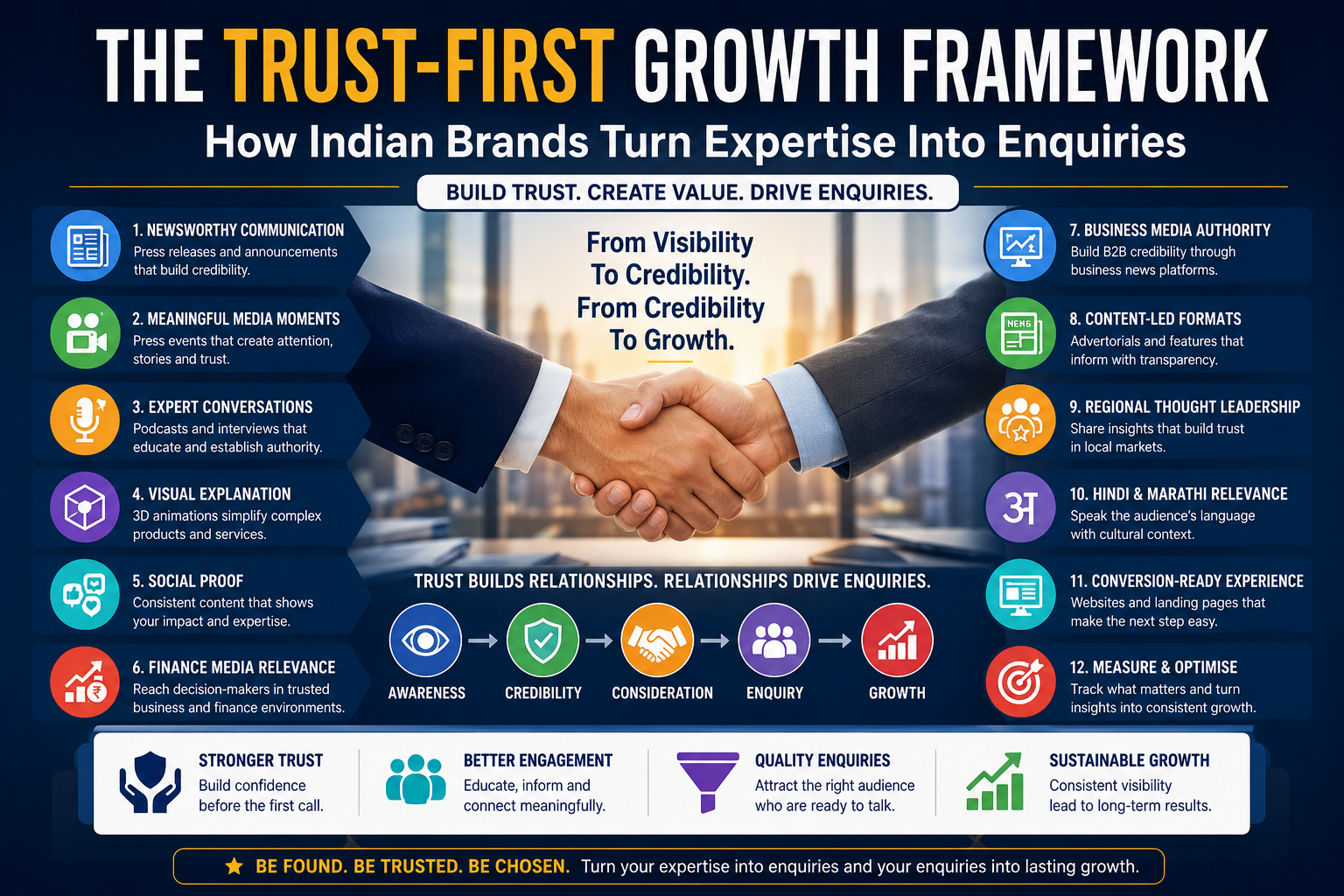
The strongest trust-first growth systems combine:
- Clear brand positioning
- Useful announcements
- Credible press and media moments
- Expert-led content
- Visual explanation
- Consistent social proof
- Business and finance media relevance
- Transparent content-led formats
- Regional thought leadership
- Hindi and Marathi audience relevance
- Conversion-ready digital experiences
- Strong follow-up after the first enquiry
When these elements work together, marketing does not just generate attention.
It creates confidence.
And confidence is what turns interest into action.